Top
Showing posts with label iPad. Show all posts

Monday, 12 March 2012

Things You Should Know About The New IPad3


On March 8, 2012, Apple introduced its "new iPad" with great expectation and fanfare. It was generally greeted with a loud "meh." And those people are missing an important insight.
For example, CNN reported "REVIEW: NEW IPAD NEITHER DUD NOR 'REVOLUTION.' On first glance, the new, never-to-be-actually-named iPad is exactly the same as its predecessor: Same size, same price, same colors."

Polishing a Great Product

with the new iPad, there isn't much more to bring to a great design other than a noticeable increase in display resolution and initially invisible increased compute power and G4 cellular network speed. And you get all of this for the same price as the last generation.
This trend was initially observed by Moore's law in 1965 - technology doubles in capability every year (plus or minus) for the same price. (For a great overview, check out Moore's Law on Wikipedia).

Most Users Miss the Value

If a tablet just replaces books, magazines, and TV screens, then advances in network speed and compute power get overlooked or ignored.
Most iPads get used as an entertainment device. These users won't think that the new iPad has much value because they don't believe that there is any advantage to them.
And that's where most people ignore and miss out on what's really happening. The reality is that higher quality video and a better resolution display demands more compute power and network bandwidth. And this offers much more capability that only a few will recognize and capitalize.

Exponential Improvements

The iPad 2 is twice as powerful as its predecessor in terms of compute power and networking speed. And the new iPad is twice as powerful again. This makes the new iPad four times more powerful then the original.
There is no reason to think that the next generation iPad won't be twice as powerful again. So in five years, the "iPad 8" will be 128 times more powerful than the original.

The Power User's Advantage

Power users will find ways to use that to their advantage. For example, if a Google search occurs in half the time, you can accomplish more. If voice commands -- three times faster than typing -- improves productivity, you become freed to do other things. If you can see more on the higher-resolution screen, then you can take in more information in a single page, speeding your tasks.
If you really want to benefit from the exponential technology curve, figure out how to use the rapidly advancing compute and network power of devices like the iPad. Get ahead of the curve with your ideas and products. In the next 24 months, you'll be able to bring to market products that 99.9% of people can't even imagine right now.

Saturday, 10 March 2012

Galaxy Tab 2 And IPad Comparison


Samsung and Apple are into court battles because of the claims of the latter copying the designs of the former. The Galaxy Tabs are one of those products that said to have been copied from the iPad. But amidst the controversies, it had enjoyed some success behind Apple. It provided some alternative for those who either have no money to spend on shinier devices or just hate all products by Steve Jobs.
Users are expecting another product when the Galaxy Tabs 2 was announced. This was during the time when the rumors of the release of the iPad 3. But when the news about the specifications of the new tablets by Samsung came out, there was nothing to be impressed about.
All the hardware remained the same as the original. There is the dual-core NVIDIA Tegra 2 which is the same with the one on the Galaxy Tab 7.0 Plus. This processor is not an improvement over the original's Exynos processor. Actually, the Exynos is faster at is clocked at 1.2 GHz while the Tegra 2 is clocked at only 1 GHz.
The screen resolution is also the same which is depressing for Galaxy Tab loyalists. This is probably because of the news that the iPad 3 will have retina display and their favorite tablet has no improvements on this area. The 10-inch version will remain at 800 by 1280 pixels and the seven-inch version will stay at 600 by 1024 pixels.
While tablets are now transitioning to 4G LTE connectivity, the Galaxy Tab 2 remains at 3G. Just like the original, you have a choice between 3G and Wi-Fi and Wi-Fi only models. The speeds are the same as original: 21 MB/s for download and 5.76 MB/s for upload.
The only improvement on the Galaxy Tab 2 is the interface as it now sports the latest Android version, Ice Cream Sandwich. This version is the best looking version of Google's mobile OS besides offering a slew of new features. Ice Cream Sandwich is Android's answer to the simple elegance of Apples iOS 5.
With all of these, it seems like the Galaxy Tab 2 is just the original upgraded to the latest Android OS. ICS is good but we would have expected something better in terms of hardware from a company such as Samsung like what ASUS did with their Transformer Pad. There could have been added functions such as NFC or, as mentioned, support for 4G LTE. No prices have been released yet for these devices. But there are rumors that they will be sold at a lesser price than the original. If this is true then the Tabs are worth a look in terms of practicality. But performance wise, the new tablets by Samsung are depressing.

Wednesday, 7 March 2012

Google Creates Hub for Buying Apps, Entertainment in One Place

Image representing Google as depicted in Crunc...Image via CrunchBaseGoogle Inc. (GOOG), stepping up competition with Apple Inc. (AAPL) and Amazon.com Inc. (AMZN) in digital media, unveiled a site called Google Play that lets users get Android applications, music, books and movies in one place.
The new service brings together Google’s various online stores that feature downloadable products, said Jamie Rosenberg, the company’s director of digital content. Mountain View, California-based Google begins to roll out the service today on mobile devices that run its Android operating system and will release a Web browser-based version for personal computers.

“Now all of your media experiences with Google live in one place,” Rosenberg said in an interview. “It can really tie it all together for consumers.”
Google is trying to capitalize on its leadership in Internet search and smartphone software to grab a bigger piece of the digital-entertainment market, which is dominated by Apple. Apple has built its iTunes music store into a source of movies, TV shows and other content. Amazon, meanwhile, is the biggest seller of electronic books.
Google Play will give recommendations based on what users previously purchased, Rosenberg said. It also will make it easier for the developers and media companies to sell their apps and content.
bloomberg

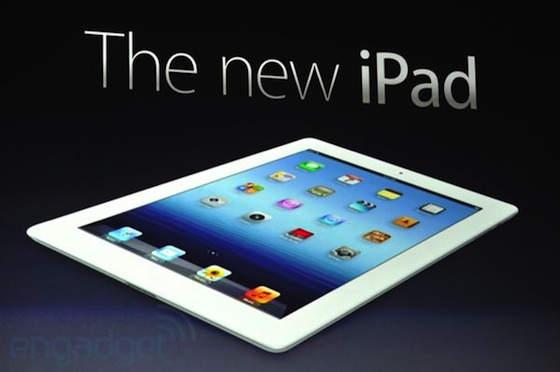
Apple Introduces The New IPad

Apple today introduced "the next iPad", the latest generation of the company's popular tablet device. Offering a Retina display measuring in at 2048 x 1536 pixels, Apple claims that it is "redefining the category Apple created" with the original iPad. At 264 pixels per inch, the new display is considered Retina quality with indistinguishable pixels when held at the typical viewing distance of 15 inches.

Featuring an A5X system-on-chip with quad-core graphics, the Retina display offer 44% greater color saturation than its predecessor. All of Apple's stock apps have been optimized for the new ultra-high resolution display and existing apps from third-party developers will be automatically scaled up with text rendered for the new resolution. With additional work, developers can also optimize their entire apps for the new display.


Image from Engadget

On the camera front, the updated iPad features a 5-megapixel rear camera with advanced optics very similar to those found in the 8-megapixel camera on the iPhone 4S. 1080p video recording is also supported. Voice dictation as found on the iPhone 4S is also included.

Cellular-capable models of the new iPad also support 4G LTE as had been rumored by multiple sources. Supporting data speeds of up to 21 Mbps on HSPA+, 42 Mbps on dual-carrier HSPA+, and 73 Mbps on LTE, the new iPad offers a significant improvement in cellular data capabilities. LTE partners include AT&T and Verizon in the United States and Rogers, Telus, and Bell in Canada. Due to differences in frequency bands, AT&T and Verizon support will require separate models.

On the battery life front, the new iPad offers the same levels as before: 10 hours on Wi-Fi or 9 hours on 4G LTE. As for the device's size, it comes it a scant 0.6 mm thicker than the iPad 2 at 9.4 mm thick, and weighs 1.4 pounds versus the 1.33-pound iPad 2.


Image from gdgt

Pricing remains as before at $499/$599/$699 for Wi-Fi models and $629/$729/$829 for 4G LTE models, with capacities coming in at 16 GB, 32 GB, and 64 GB. The new iPad launches on March 16 in the United States, Canada, United Kingdom, France, Germany, Switzerland, Japan, Hong Kong, Singapore, and Australia.
Macrumours

Apple iPad 3 release date


ipad-3-rumours-what-you-need-to-know

The iPad 3 release date will be March or April 2012. We now know there will definitely be an iPad 3 launch event on 7 March and we'll probably also see the release of iOS 5.1 at the same time.
We'd expect the iPad 3 US release date to be in early March and the iPad 3 UK release date later in the month.
Apple news site iMore was right in saying the announcement would be 7 March, citing sources "which have proved reliable in the past" have confirmed the date ahead of any official announcement from Cupertino.
On 27 February it was reported that the iPad 3 was ready to ship from Foxconn in China and a shipment would arrive in the US on 9 March.
Digitimes reported in late November 2011 that panel makers had already started shipping panels for the new iPad 3 - a million in October and two million in November.
Foxconn, Apple's major manufacturing partner, is said to have started production of the iPad 3 in January. 2012. A source at one of Apple's partners also told Bloomberg also stated that the company began production of the iPad 3 in January, with a view to reaching full volumes in February.
Digitimes reckons the new model is expected to meet the heady heights of 9.5 to 9.8 million units over the course of Q1 2012.

Monday, 5 March 2012

I Swifter makes iPad game streaming available to all PC game companies


iSwifter found a niche for its cloud streaming service by enabling Flash games to run on the iPad. Now it is extending its platform so that a wider swatch of PC game companies can stream their games to Apple’s tablet.
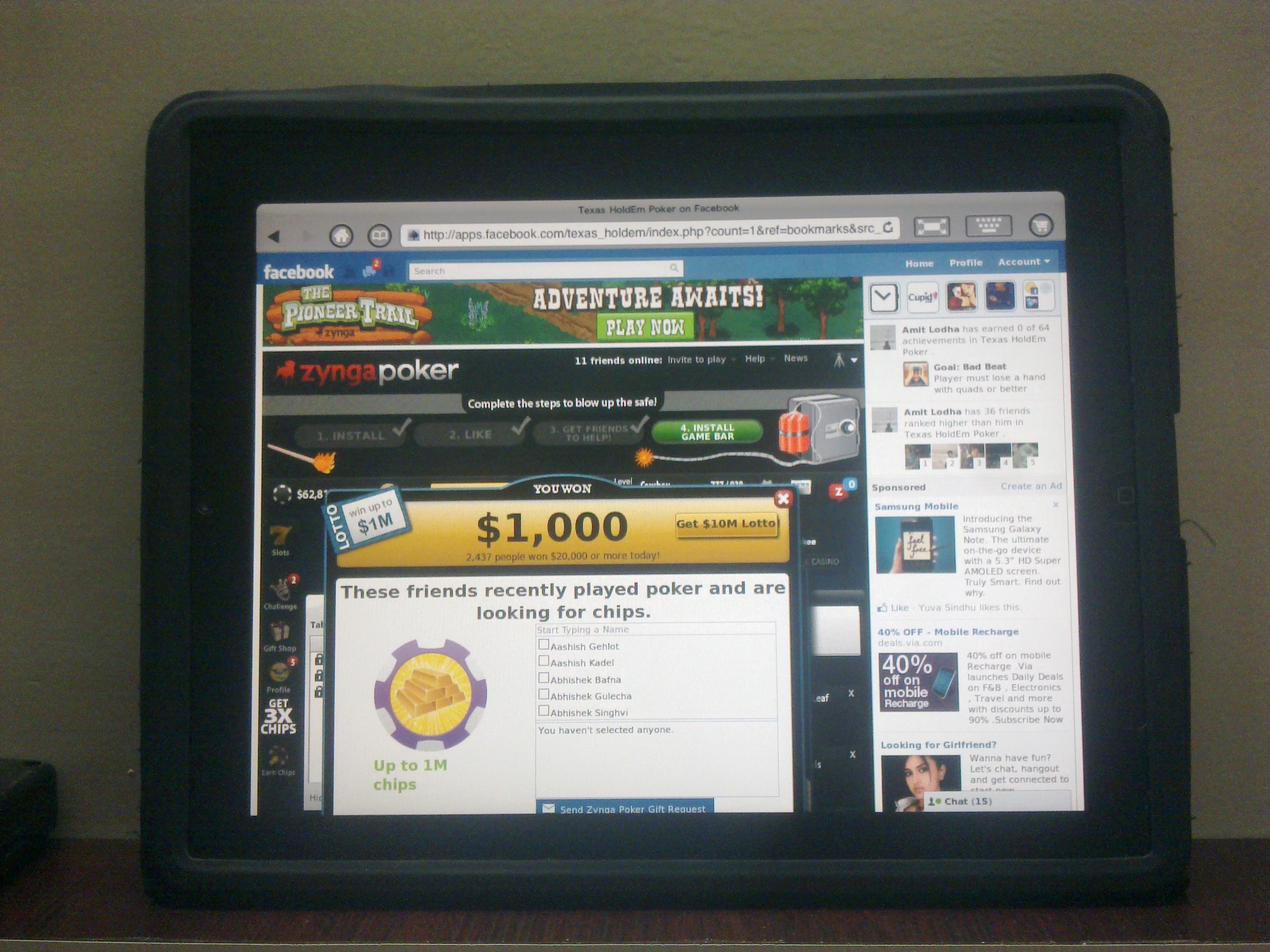
This means that PC game makers will be able to take games from their older library of games and, without much effort, get them running on an iPad. As you can see from the picture above, iSwifter has been able to adapt Blizzard Entertainment’s original StarCraft game. As such, iSwifter can make it easy for game publishers to find a new source of revenue from their older games by adapting them to new platforms where users are plentiful.
“We are bridging the applications of the PC era with the devices of the mobile era,” said Rajat Gupta, chief executive of iSwifter, in an exclusive interview with VentureBeat.
Menlo Park, Calif.-based iSwifter takes advantage of the cloud, or web-connected data centers. It runs a game such as Flash-based Facebook games in the cloud. Then it streams video of the games at high speeds to a mobile device such as an iPad. The interaction over a broadband connection is fast enough so that the user doesn’t notice that the game isn’t actually stored or computed on the iPad. The service operates functionally much like Onlive’s or Gaikai’s cloud gaming services.
Since Adobe gave up on running Flash on mobile devices, it has created a big problem for developers who have a lot of content on the social networks or the web and want to move it to the iPad. But it’s hard for them to do this if it means rewriting a lot of code. iSwifter handles the conversion and makes it possible to run the exact same Flash game on an iPad.Users can download iSwifter’s browsing app and play it free for 30 minutes; after that, it costs $4.99. The games run smoothly as if they were running in a native format.
While OnLive and Gaikai are using streaming to reproduce a high-end 3D graphics experience on lesser hardware, iSwifter isn’t going that far. it is taking games with medium-quality graphics and getting them to run on new devices.
“Now we’re ready to apply this technology in a broader way,” said Peter Relan, chairman of the YouWeb incubator that spawned iSwifter in 2010. iSwifter has since spun off and become its own company with 30 employees, in an interview with VentureBeat. “We want to license it to PC makers who want their games streamed to iOS and Android mobile devices.”
Relan said that iSwifter was growing at a $10 million annual run rate. The company has already licensed its iSwifter technology to an unnamed large game publisher that plans to convert a library of PC games to run on iSwifter on the iPad. That company and a couple of other licensees are likely to launch games in the second quarter.
Over time, iSwifter will like be expanded so that it can handle multiple applications, not just games. It could do productivity apps, much like OnLive does with its Office-capable OnLive Desktop service. iSwifter has also launched its Rover browser for educational purposes. As iSwifter expands into other territory, it will compete head-on with OnLive, which has also moved into iSwifter’s market on the iPad.
“This can be expanded to bring rich interactive apps to any mobile devices,” Relan said. “It opens up a whole new world of business.”
Gupta said the company will try to recruit more licensees at this week’s Game Developers Conference in San Francisco.

Everything About Ipad 3


Friday, 2 March 2012

Apple Ipad VS Windows 8

ipad vs windows 8 comparison
Microsoft's Windows 8 Consumer Preview was made available to download yesterday, giving everyone a chance to experience the company's most revolutionary change in user interface since Windows 95. The interaction paradigm has shifted from a mouse-centric desktop to a touch-friendly, highly visual Metro style UI. The old Start orb has been retired and replaced by a Charms bar, which is brought to life with an inward swipe from the right. A swipe from the top down dismisses the app you're in and returns you to the home screen, and the left and bottom edges also have actions associated with them. Gestures play a very significant role in Windows 8, but they're only one aspect of a truly gargantuan list of changes.
While the Consumer Preview software remains at the beta stage, its central concepts have now been fleshed out, so we thought this would be a fitting time to compare them against Apple's iPad, the incumbent leader in the tablet space Microsoft is seeking to become a player in. iOS 5 and Windows 8 share a few similarities, but the user experience is fundamentally different and informed by different interaction metaphors. You can see those detailed in the video below, and if you care to learn more about what else has changed under the Windows hood with version 8, feel free to peruse our comprehensive preview of the Consumer Preview.

Twitter Delicious Facebook Digg Stumbleupon Favorites More